

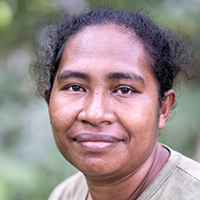
By: Elisabeth Karma, Head of the Fyarkin Group, Numfor Island, February 15, 2025
This story begins with the Saribi and Submander Village communities, Orkeri District, Biak-Numfor Regency. Where in the past, this village community had a different way of life from the way of life today. A village elder, Bapa Bertus Rumbrawer said,
“Sinan epon siwara siswar yaye si imbape babo ine oroba. Rupara farfur yafe randak iwar ido sifararur kayam e babo ine ido, sufur yaf ido sifararur wesisye, ramnai sranda sraswan sun in ma smun randip (ben sup) ido kan kayam eee”
“Our parents used to live together, but now they don’t. In the past, if they wanted to garden, they would clear the land together. Now, this activity is done individually. If someone used to catch something like a pig, they would enjoy it together. Something that can no longer be felt.”
The loss of togetherness also affected the ability to fulfill basic needs. Food was not met properly and increased dependence on assistance such as Bansos, BLT, Raskin and Village Funds. That was when YP3SP came to conduct a workshop in our village in a process called learning together. This learning together process then gave rise to the idea in some people that, “There is something wrong with the way we live now, such as going into debt to eat because we don’t garden.”
Therefore, we then decided to create a group called Fyarkin. Fyarkin in the Biak language is farkin, which means ‘being fostered or led in a better direction’.
Formation of the Fyarkin Group
At the beginning of the formation of the group, there were 40 people who joined as members. However, the number decreased over time. The reason they resigned was due to the difference between their expectations and the reality. They hoped that the formation of the group as usual would be a requirement to receive government assistance. In reality, Fyakin did not receive any assistance in the form of money or assets from YP3SP.
Currently, there are only nine members of the Fyarkin group, including three administrators who were newly appointed after almost two years of the group’s formation. The decision to eliminate the management was indeed an agreement of the members from the beginning. With the reason that everyone is responsible for themselves and the group. That is also our way of avoiding a situation where one person will feel like they are the boss of others.
Until the time came when Fyarkin faced problems within the group that caused the production process to stop for almost three months. That’s when we realized that we still needed the people we appointed and gave them responsibility. August 17, 2022 was the day we elected and appointed the first Fyarkin group administrators, consisting of a Chairperson, Secretary, and Treasurer.
Restoring Togetherness and Fulfilling Basic Needs
To restore togetherness, the Fyarkin group began by routinely practicing traditional traditions, such as kakes, mansorandak, and sasi. Kakes is the giving of betel nut, sirih, and chalk to welcome guests who come to the house. This signifies a bond of affection. We do these practices to everyone regardless of status.
Mansorandak is a custom to welcome new people who first come to the village or home. This is a form of acceptance of the person as part of our village and home (stepping and giving plates). In the past, this procession was usually carried out, which then began to decrease and was only carried out symbolically when welcoming amber guests and government officials. We at Fyarkin are trying to restore the true meaning of mansorandak. So far we have carried out the mansorandak procession by bringing out around 38 plates to welcome friends from other communities such as the Paia group from Merauke, Sinara from Kaimana, Bapa Dimara from DPMK Biak-Numfor Regency, the Homestay Association from Raja Ampat, and Fyarkin members themselves when they return from a new place they have visited.
Sasi is a form of respect for the sea and forest, in the form of a prayer prohibiting the taking of fish and plants that has been marked with a certain time limit. To get more and bigger fish, sea sasi is needed, as well as plants.
The last sea sasi we did was in the early February to July 10, 2023. The results of the opening of the sasi were to be eaten together at the inauguration of the church building. Fyarkin was directly involved in making decisions about the sea sasi activities. Fyarkin members also took their own initiative to carry out the areca nut and betel sasi planted in their respective yards. By doing these things, we began to re-establish the togetherness that had been lost between us.
To meet basic needs, we started opening personal and group gardens, producing coconut oil, VCO, sago-kasbi, and salted fish. Because our production volume is still small, the results are limited to our own consumption. Only if there is excess do we sell it. This decision led us to gradually stop relying on aid and debt for our food needs.
Another activity of our group is to independently plant 50×20 meters of mangrove, led directly by Bapa Bertus Rumbrawer. This activity aims to protect our coastal residence, and also provide a place to lay eggs for fish which are one of the biggest products of our village.
We also replanted around 60 coconuts on each member’s land to ensure the sustainability of VCO and coconut oil production. Currently, many coconut trees are too old and do not produce maximum results. From our production so far, we have been able to buy a small grating machine as a production tool, so we no longer need to rent. For us, this is a proud success.
Awareness Built by the Fyarkin Group
With all our activities, the village community around us began to realize that actions and mindsets greatly influence the lives we live. Survival—especially regarding food—is not the responsibility of other people or the government, but the responsibility of each person.
Another achievement that we feel as members of the group is our efforts to influence government policies by being directly involved in the decision-making process. Efforts that are not easy and drain a lot of energy and tears.
One example is the village deliberation (muskamsos) for the Village Fund program which took place in early 2022. In the deliberation, assistance was allocated for our group worth IDR 11,250,000 in the form of 15 grating machines at a price of IDR 750,000 per unit. However, when it was realized, we only received 10 machines at a price of IDR 350,000 per unit. At that time we were really disappointed and felt cheated. This then ended with a mutual agreement within the group not to accept and reject the assistance.
Without us realizing it, our decision inspired not only other community members, but also the village officials. They apologized, making it an important lesson, especially for the village head at that time, not to arbitrarily change things that were proposed and agreed upon in the village meeting.
This incident also made the current acting village head—Father Otniel Rumaseb—give support and appreciation to Fyarkin as a ‘community group formed by the community itself’.
Motivation to Continue to Survive as a Group
The difficulties we faced on our journey as a group were long and tiring. There were times when we wanted to give up and stop. But on the other hand, we continued to receive support, encouragement, and motivation, not only from YP3SP family and friends, but also from the village government.
One form of support and appreciation from the village government is that for two consecutive years the Head of Orkeri District—Mr. Tommy Sroyer—asked our group to represent Orkeri District in VCO oil training organized by the Biak-Numfor Regency Industry and Trade Service.
From this activity, we received assistance in the form of a grating machine, a squeezing machine, a stove, a cauldron and other oil production tools. These assets are what we use to produce and slowly start building a production house. We built this production house independently. We did it ourselves by involving group members and helpers from each family.
In accordance with Fyarkin’s dream, I slowly began to see changes, both individually and as a group. In addition to trying to take care of ourselves, we also continue to be involved and struggle in facilitating similar changes, together with our own village community and with the communities of the villages around us. To name a few: Wansra Village, Yenbepon Village, Yenmanu Village, and Sauribru Village, which were inspired after seeing the process of change that Fyarkin members experienced.
 ID
ID